
User experience in web design means creating sites that feel intuitive and satisfying for visitors. It focuses on how people navigate, find information, and interact with your content. Prioritizing this leads to higher engagement and better business results.
Key Points / Quick Summary
• User experience shapes first impressions and keeps visitors on your site longer.
• Good UX boosts conversion rates by making actions like form submissions simple.
• It improves SEO through lower bounce rates and higher user satisfaction.
• Responsive design ensures a great user experience across all devices.
• Investing in UX delivers a strong return on investment for businesses.
What Exactly Is UX in Web Design?
UX stands for user experience. It covers every aspect of how someone interacts with your website. Think about the layout, navigation, and how quickly pages load. UX design aims to make these elements work together smoothly. We at Suncode Miami see UX as the foundation of effective web design. With over 10 years of developing high-quality web projects, we know a well-designed user interface paired with thoughtful UX creates sites that attract and retain users.
A good website goes beyond looks. It addresses user needs right from the start. For instance, understanding your users helps tailor the experience. We start by creating personas to represent your target audience. This ensures the design aligns with what they want. Here’s why this matters. Users expect sites to load quickly and offer easy-to-find information. If they struggle, they leave. Bad UX leads to poor user satisfaction and lost opportunities.
Let’s look at it this way. UX determines if visitors find what they’re looking for without frustration. It includes elements like font choices, color schemes, and calls-to-action. These details build trust. In our experience, sites with great user experience see repeat visits and higher conversion rates. We always emphasize a user-centric approach to make interactions feel natural.
Why Is the Importance of User Experience in Web Design So Critical Today?
The digital world moves fast. People access websites from mobile devices more than ever. A site that offers experience across all devices wins. The importance of UX lies in its ability to drive conversions and build loyalty. Businesses ignore this at their peril. Poor user experience, or bad UX, results in high bounce rates. Users won’t stay longer if the site feels clunky.
We see this in our projects. Investing in UX improves your website’s performance. It streamlines navigation and makes content relevant. This leads to better user experience and business metrics like increased sales. Search engine optimization benefits too. Google rewards sites with good UX through higher rankings. Next steps involve assessing your current site. Look for usability issues and fix them.
Aesthetically pleasing designs paired with functional UX create a positive first impression. Users navigate easily, finding different pages without hassle. This user-friendly setup encourages exploration. We recommend starting with a redesign if your site has outdated elements. It pays off in ROI.
How Does UX Impact Conversion Rates?
Conversion happens when visitors take desired actions, like form submissions. UX plays a direct role here. A better user experience makes these actions effortless. For example, clear calls-to-action guide users. We design sites with this in mind, ensuring higher conversion rates.
Bad UX frustrates users. They abandon carts or leave pages. Good UX design fixes this by optimizing layouts and reducing steps. In our work, we’ve seen conversion boosts from simple changes like mobile-friendly adjustments. Users on mobile devices expect seamless interactions. If your site isn’t responsive, you lose them.
Here’s why UX drives conversions. It builds trust through consistent design. Visually appealing elements combined with easy navigation keep users engaged. We use prototypes to test these features early. This avoids costly fixes later. Businesses see real gains, like more leads and sales.
Read: Flat Design vs Material Design: Key Differences
What Role Does Navigation Play in User Experience?
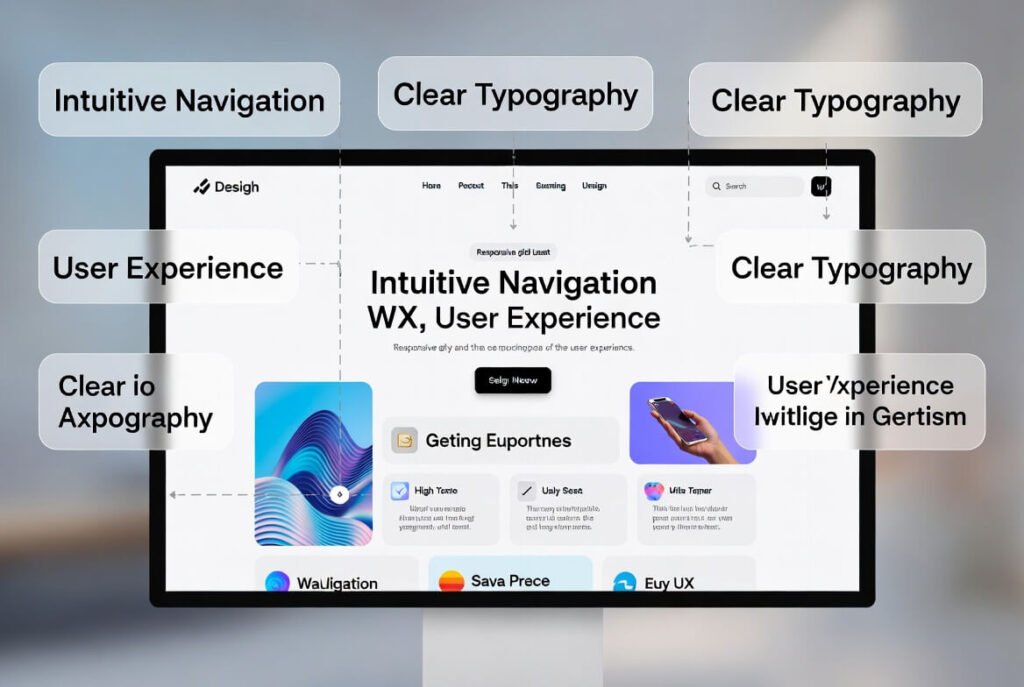
Navigation is key to user experience on websites. It helps users find what they need quickly. Poor navigation leads to frustration and exits. We focus on intuitive menus and logical structures. This ensures users navigate without confusion.
Ease of navigation improves the user experience. Think about breadcrumb trails or search bars. These tools make sites user-friendly. In web design, we prioritize this to reduce bounce rates. Well-designed navigation encourages exploration of products or services.
We test navigation through usability sessions. Feedback reveals issues. Fixing them creates a great user experience. Businesses benefit from users who stay longer and convert more.
Why Is Responsive Design Essential for UX?
Responsive design adapts sites to any screen size. It provides a consistent experience across all devices. Mobile users expect this. Without it, text shrinks or buttons misalign. This ruins UX.
We build responsive sites from the start. It optimizes for desktops, tablets, and phones. Users accessing websites from anywhere get the same quality. This boosts satisfaction and retention.
Google favors responsive sites in rankings. It ties into SEO. Businesses see more traffic and conversions. Invest in this for a competitive edge.
How Does Accessibility Fit Into UX Design?
Accessibility makes sites usable for everyone, including those with disabilities. It includes alt text for images and keyboard navigation. We follow standards like WCAG to ensure this.
Good accessibility improves UX for all. It expands your audience. Ignoring it leads to poor user experiences. We audit sites for issues and fix them.
Businesses gain from inclusive design. It builds reputation and avoids legal risks.
What Are the Benefits of a User-Centric Approach?
A user-centric approach puts users first. It leads to effective UX by addressing needs. We use research to understand behaviors. This creates tailored recommendations and relevant content.
Benefits include higher engagement and loyalty. Users feel valued. This drives repeat visits and referrals. For businesses, it means better metrics and growth.
We implement this through personas and testing. It ensures designs resonate.
How Can You Identify and Fix Usability Issues?
Usability issues hinder UX. Spot them through testing. We watch users interact and note pain points.
Fixing involves redesign. Streamline processes and clarify elements. This creates user-friendly websites.
Regular checks prevent bad UX. Businesses see improved performance.
What Is the Difference Between UX and UI?
UX focuses on overall feel and efficiency. UI handles visuals like buttons and fonts. Both matter, but UX drives the strategy.
We integrate them for cohesive sites. Good UX design includes strong UI.
How Does UX Influence SEO?
UX directly affects SEO through user behavior signals that Google values highly. Sites with low bounce rates, longer session times, and fast, smooth interactions get ranked higher. We optimize for Core Web Vitals (speed, interactivity, visual stability) and mobile responsiveness, which improves visibility and attracts more organic traffic.
Click here is you want to learn about Web Development: Best Resources
How to Improve the User Experience in Your Web Design: Step-by-Step Guide
Step 1: Research your audience. Create personas to understand needs.
Step 2: Map user flows. Identify paths to key actions.
Step 3: Design wireframes. Sketch layouts for feedback.
Step 4: Build prototypes. Test interactions early.
Step 5: Conduct usability testing. Gather real user input.
Step 6: Iterate based on data. Refine for better performance.
Step 7: Launch and monitor. Use analytics to optimize ongoing.
This process ensures a great user. We follow it in our projects.
Read: Web Development Career Outlook: Worth It? (Yes!)
How Does Investing in UX Provide Return on Investment?
Investing in UX yields high ROI. It reduces redesign costs and boosts conversions. Businesses see up to 100x returns.
We calculate this through metrics like retention. Good UX design pays off quickly.
Why Should Businesses Prioritize UX Designers?
UX designers bring expertise. They create user-centric sites. We hire them for innovative solutions.
They fix bad UX and enhance good ones. This elevates online presence.
What Makes a Website Visually Appealing Yet Functional?
Balance aesthetics with usability. Use clean layouts and intuitive elements. We blend these for impactful sites.
How Can Digital Marketing Benefit from Strong UX?
Digital marketing thrives with good UX. It supports campaigns by keeping users engaged. We link UX to strategies for better results.
FAQ
What is the importance of user experience in web design? The importance of user experience in web design comes down to one simple truth: people only stay on websites that feel easy and pleasant to use. A strong UX helps visitors quickly understand your offer, find what they need, and take action – whether that’s filling out a contact form, making a purchase, or scheduling a call. When UX is ignored, visitors leave fast, bounce rates climb, and your business loses potential customers before they even get to know you. Good UX turns casual visitors into engaged leads and loyal clients.
What is UX? UX (user experience) is the overall feeling a person gets while using your website – from the first click to the last. It includes how logical the navigation feels, how fast pages load, whether buttons are easy to tap on mobile, and if the content is presented in a clear, helpful way. At its core, UX answers the question, “Did this website make my task easier or harder?” We treat UX as the invisible bridge between beautiful design and real business results.
How does bad UX affect a business? Bad UX quietly kills businesses. Visitors arrive, get confused by unclear menus or slow loading times, feel frustrated, and leave – usually within the first 10–15 seconds. This spikes bounce rates, lowers your search rankings over time, wastes advertising dollars, and sends potential customers straight to competitors. We’ve seen clients lose thousands in monthly revenue simply because forms were too long, buttons were challenging to find, or the mobile version felt broken. Fixing bad UX is one of the fastest ways to recover lost conversions.
What is a persona in UX? A persona is a detailed, research-based profile of your ideal customer – not just demographics, but their goals, frustrations, habits, and typical behavior online. For example, “Maria, 38, small business owner in Miami, checks email on her phone at 7 a.m., hates long forms, and wants pricing information visible in under 10 seconds.” We create 2–4 personas per project so every design decision is guided by real user needs instead of assumptions. Personas keep the team focused and prevent “designing for ourselves.”
How can I improve my website? Start small and be systematic. First, run a quick usability test: ask 5 real people (not friends or employees) to complete a key task on your site while you watch silently. Note where they hesitate or get stuck. Next, make sure the site is fully mobile-friendly and loads in under 3 seconds. Simplify navigation to no more than 7 main menu items. Place the most important call-to-action above the fold. Then test again. Small, data-driven changes like these usually deliver the biggest lifts in engagement and form submissions.
What is optimization in UX? Optimization in UX means constantly measuring how real people behave on your site and making targeted improvements based on that data. Tools like heatmaps, session recordings, and Google Analytics show exactly where users drop off, click too much, or scroll past important content. We then tweak layouts, shorten forms, enlarge buttons, rewrite confusing copy, or rearrange elements. It’s an ongoing cycle – never “done.” The goal is to remove every tiny friction point so visitors convert more easily and happily.
What is a prototype? A prototype is an interactive mockup of your website that lets you test functionality before writing a single line of final code. It can be as simple as clickable wireframes in Figma or as advanced as a near-final version with real content and animations. Prototyping saves huge amounts of time and money because you discover navigation problems, confusing flows, or missing information early – when changes are cheap. We always build and test prototypes with actual users before moving to development.
Why is mobile-friendly design important? More than 60% of web traffic now comes from mobile devices, and that number keeps growing. If your site isn’t mobile-friendly, buttons are too small to tap, text is tiny, images load slowly, or the layout breaks, users will leave immediately – often angry. Google also penalizes non-responsive sites in mobile search results. A truly mobile-friendly (responsive) design automatically adjusts layout, font sizes, and touch targets so the experience feels natural on phones, tablets, and desktops alike. It’s no longer optional; it’s table stakes.
What is search engine optimization? Search engine optimization (SEO) is the practice of helping search engines understand and rank your website higher for relevant searches. While many people think SEO is only about keywords and backlinks, user experience is now one of the biggest ranking factors. Google measures things like how long people stay, how quickly pages load, whether the site is mobile-friendly, and how easy it is to navigate. When UX is excellent, users engage more → signals improve → rankings rise → more organic traffic arrives. It’s a virtuous cycle.
How does UX lead to higher conversion rates? UX removes obstacles between a visitor and the action you want them to take. When navigation is clear, pages load fast, trust signals (testimonials, secure badges) are visible, forms are short and logical, and calls-to-action stand out, people feel confident clicking “Submit” or “Buy Now.” Every friction point you eliminate – confusing wording, extra steps, tiny buttons – increases the percentage of visitors who convert. We’ve seen form-submission rates double or triple after focused UX improvements, often without changing the offer itself.
What is a user interface? The user interface (UI) is the collection of visual and interactive elements someone actually sees and clicks: buttons, icons, typography, colors, spacing, input fields, menus, images, etc. UI is what people touch; UX is how that touching feels overall. Great UI supports great UX – clean buttons, readable fonts, consistent colors, and logical placement all make interactions smoother and more enjoyable. We design UI so it feels familiar and effortless, never fighting against what the user expects.
Why avoid poor user experiences? Poor user experiences damage trust, reputation, and revenue faster than most people realize. A frustrated visitor doesn’t just leave-they often tell friends, leave bad reviews, or post complaints online. Meanwhile, your advertising budget keeps burning while fewer people convert. Over time, poor UX trains search engines to rank you lower and trains users to ignore your brand. The cost compounds quietly until it becomes expensive to fix. Preventing poor experiences from the beginning is far cheaper and smarter than repairing them later.
What is the digital world like for UX? The digital world today is impatient and mobile-first. People switch between apps and websites constantly, expect near-instant loading, and judge businesses in seconds. Attention spans are short, competition is one tap away, and users have zero tolerance for confusion or slowness. In this environment, UX isn’t a “nice-to-have” luxury – it’s the main competitive advantage. Companies that deliver fast, clear, respectful digital experiences win loyalty and market share; everyone else gets left behind.

